
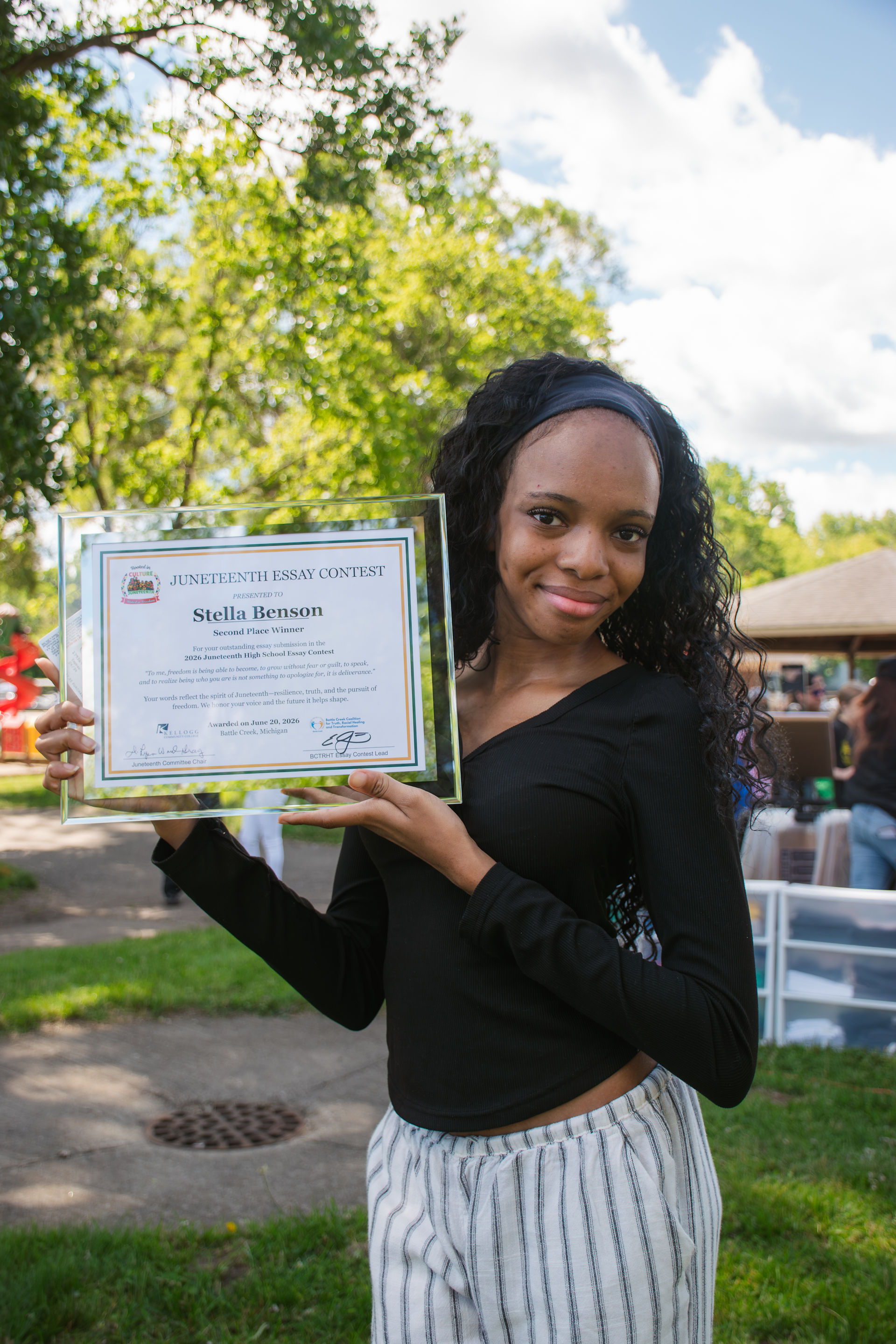
"It Ends With Us" Stella Benson, 2026 Juneteenth Essay Contest

The 2026 Juneteenth High School Essay Contest invited high school students in the Battle Creek area to respond to this year's prompt, rooted in the theme Rooted in Culture. United in Freedom.
"Juneteenth reminds us that freedom was delayed, fought for, and passed down. The roots go deep. Who or what in your culture has shaped your understanding of freedom, and how does that connect you to the people around you?"
This year we received 18 essays from students across the Battle Creek area. Stella's essay tied for second place.

It Ends With Us
“I felt suffocated, as though the air was too heavy to breathe”. If you haven't heard this quote before, it means that you have not read “Purple Hibiscus” by Chimamanda Ngozi Adiechie. When I first read Purple Hibiscus and the story of Kambili, the book itself didn't just stand out to me, it's the way Chimamanda was able to reflect a surprisingly difficult topic about African households, the yearn for freedom and self expression in youth. While I read this book, I recognized an ache I knew all too well. In many Nigerian households, the youthful journey is structured through harsh discipline, silence, blind obedience that neglects youth self expression. That freedom does not become their own, it becomes something that is controlled and delayed, and before I understood the concept of political freedom, I learned about emotional freedom while not having it at all.
In African households, toxic and strict parenting is passed down from grandparent to parent like a treasured family ring, and sometimes just because something is inherited doesn't make it a good thing. In a world where different years and eras come with change, like a new fashion trend or a new technological feature, parenting often doesn't follow this trend as generations learn to raise their children the same way they were trained, in fear, silence and control, and because change is scary these patterns stayed and youth learned how to obey and survive, but at what cost. In the world of Purple Hibiscus, Kambili exists in an environment where her obedience and silence is praised and her sense of individuality is disciplined. She suffocated in an environment where the wrong word, body language, routine, and even rest can be punished. Many people would read Purple Hibiscus and call her father the villain, the antagonist, and an angry man who needs to be sent to the nearest nursing home. That's how I felt when I first read the book, but after living my own life as a teenager and surrounding myself with other youth who come from African parents, and even a toxic household of other cultures, I realized the problem wasn't Kambili’s dad, it's the parenting structure he adopted that confuses love and care with control and discipline. And understanding this dynamic, exposes a reality that many youth already recognize. Parents providing love and care in a form of fear and control, can make youth feel like they don't deserve freedom at all. Freedom and self expression in youth is not about rebellion and revolting, it is about developing. When youths are given that space to make mistakes and grow, they learn from those mistakes and bloom into mature and independent people, but when that space is not given to them, youthfulness becomes performative and fake and a journey to please other people watching you run your own race.
The past 2 years I've spent in America showed me a completely different version of youth and freedom. Of course, nowhere is perfect and American homes have their own unique structures, but America opened my eyes and showed me what freedom truly looks like for youth, adults, and whatever race or gender you are. For instance, my first ever culture shock, seeing students question the authority of their teachers and adults and not get smacked across the face, or worse. Where I come from, a teacher walking in with a stick in their hand was enough given fear to silence your breathing, so watching youth over here speak, express themselves and question authority no matter who it is from made me realize that independence is expected from youth, freedom here is not just political, it is emotional, powerful and sign of development. In Kambili's story, the way Kambili behaved in her Aunts house was completely different compared to how she behaved in her own home. She felt true happiness that allowed her to laugh and express herself and make mistakes without feeling like it was a crime to make one. She started to become. And the way she thrived in an environment that encouraged these things was not accidental, that bloom occurs when youth are provided with the space they need to be youth. Kambili's story mirrors the experience that many youth face today, they are trying to break this cycle without breaking the culture behind it.
This is where Juneteenth becomes clear to me. Celebrating Juneteenth is a generational and emotional reminder that youths are redefining freedom and breaking chains. And while physical ones are broken, there are chains that stay invisible. The story of Kambilis shows that those invisible chains can exist anywhere, even in your own home and Juneteenth is a promise that those chains will be broken and liberation will be given. Therefore, whether you are Black, African, Carribean, White or not, we are youth and we fight for freedom. To grow, evolve and break the cycle to create better ones for the generation after us and to evolve our culture from what it was before. So to answer the prompt, My culture taught me freedom by showing me what protection looks like when it becomes limitation, and America showed me what freedom looks like when a visage become an identity, and Kabili showed me that the cycle of freedom in youth can transform from a withered red hibiscus , to a blossomed purple one. And the ones that plant that Purple hibiscus are the youth that surround us today and want to make a change. To me, freedom is being able to become, to grow without fear or guilt, to speak, and to realize being who you are is not something to apologize for, it is deliverance.
The High School Essay Contest is led and coordinated by the Battle Creek Coalition for Truth, Racial Healing and Transformation (BCTRHT) as part of the Juneteenth Planning Committee's annual celebration.

Comments